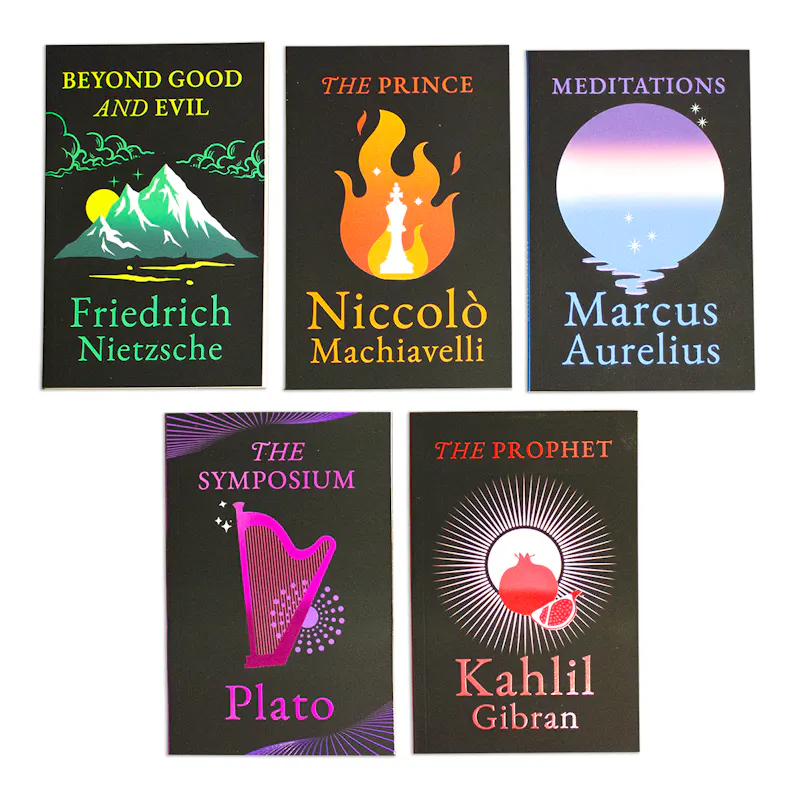
Various AuthorsThe Classic Philosophers Collection (5 Books)

R399
About
Titles in this must-have collection:
- Beyond Good and Evil by Friedrich Nietzsche
- The Prince by Niccolo Machiavelli
- Meditations by Marcus Aurelius
- The Symposium by Plato
- The Prophet by Kahlil Gibran
Beyond Good and Evil
In Beyond Good and Evil, Nietzsche accuses past philosophers of lacking critical sense and blindly accepting dogmatic premises in their consideration of morality. Specifically, he accuses them of founding grand metaphysical systems upon the faith that the good man is the opposite of the evil man, rather than just a different expression of the same basic impulses that find more direct expression in the evil man.
The Prince
Drawing on examples from the ancient Greeks and Romans and from Machiavelli’s contemporaries, The Prince offers – some believed with satirical intent – advice on how a ruler should preserve his power, conduct and warfare, and maintain his reputation. Machiavelli not only influenced many of the great statesmen of his age, but was also one of the founding fathers of modern political thought. The Prince, written in 1513 and published in 1532, is one of the most famous pieces of writing of all time.
Meditations
Written in Greek by the only Roman emperor who was also a philosopher, without any intention of publication, the Meditations of Marcus Aurelius offer a remarkable series of challenging spiritual reflections and exercises developed as the emperor struggled to understand himself and make sense of the universe. While the Meditations were composed to provide personal consolation and encouragement, Marcus Aurelius also created one of the greatest of all works of philosophy: a timeless collection that has been consulted and admired by statesmen, thinkers and readers throughout the centuries.
The Symposium
In the course of a lively drinking party, a group of Athenian intellectuals exchanges views on eros, or desire. From their conversation emerges a series of subtle reflections on gender roles, sex in society, and the sublimation of basic human instincts. The discussion culminates in a radical challenge to conventional views by Plato's mentor, Socrates, who advocates transcendence through spiritual love. The Symposium is a deft interweaving of different viewpoints and ideas about the nature of love - as a response to beauty, a cosmic force, a motive for social action, and as a means of ethical education.
The Prophet
Utterly unique and beloved around the world, The Prophet is a collection of twenty-six poetic essays by the Lebanese artist, philosopher and writer Khalil Gibran. Telling the story of the prophet Al-Mustafa and his conversations with various acquaintances as he returns home after a long absence, the book touches on subjects of universal concern, including love, friendship, passion, pain, religion and freedom.